Kahle Appraisals

  • Home
  • About
    • Tracey Kahle
    • Credentials
    • Community Involvement
  • Beyond Worth
  • Services
    • Preferred Service Provider
    • Partner Appraisers
  • FAQ
  • News
  • Contact

The Big Three – Part III, Emerald

Home/Archives foradmin

Emerald

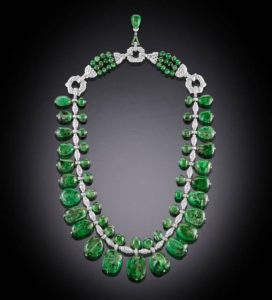
Cartier Art Deco emerald and diamond necklace

Emerald was regarded as magical and mystical to ancient Egyptians.  The Inca and Aztecs found great wealth in the abundant emeralds of the Yucatan. Eventually, Spaniards, who discovered the western hemisphere, returned to Europe with the finest emeralds they had ever seen. Hernando Cortes, the conqueror of Mexico, tried to bring huge chunks of Emerald that he took from the Aztecs back home with him. However, one of his ships was shipwrecked, and delicately carved Emeralds in the shape of flowers and fish and other rare Emeralds, including an Emerald the size of a man’s palm were lost forever.

Colombia, Brazil, and Zambia are major sources of emerald. Colombia, however, is well known for the finest quality and commands a premium. Emeralds, by nature, are more heavily included than other gems.  To find an eye-clean emerald is extremely rare.

Zambian emerald rivals the saturation of Colombian emeralds. However, they tend to be darker in tone. Zambian emeralds are generally cleaner internally than Colombian, so they tend to be a great option for the middle price range.

Brazil is the main source for commercial color emeralds. Washed out in appearance, they do have the redeeming quality of above-average clarity.

Emerald Treatments
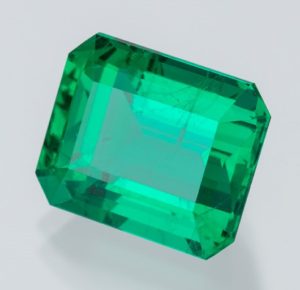
loose emeraldEmeralds are routinely “oiled” to reduce the visibility of natural fractures within the stone. Oiling, and more recently Opticon (an epoxy resin), impregnation is an acceptable trade practice and has been for well more than a century.  Occasionally, dye is added to the oil to enhance color.  This is not considered acceptable in the trade.

The emerald market suffered in the early 2000’s due to some controversy over oiling treatments, disclosure, and pricing of emeralds in relation to the extent of oiling. Prices fell 30%-50% and the market remained soft for several years until a recent resurgence.  Emerald prices have just recently seen a full recovery from that downturn.

Trapiche Emerald
Trapiche emerald
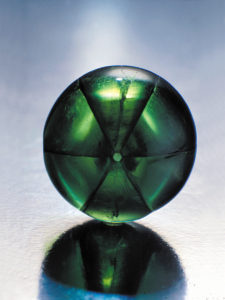
Trapiche emerald

Trapiche emeralds are an extremely rare variety of emerald. Cut in cabochon form, they display a hexagonal center with six radiating sections, following the growth of the original crystal. These rarities are found only in the Muzo mining district of Colombia. The Spanish name trapiche was attached to this unique gem due to its similarity in appearance to a wheel used for grinding sugar. A top quality trapiche emerald may display a glow or chatoyancy caused by fine needle-like inclusions.

Emerald is May’s birthstone and represents the 20th and 35th wedding anniversaries. This gem can be worn in a ring, but special care is recommended in wearing.  Emeralds should never be cleaned by ultrasonic or steamer. Soap and water with a toothbrush is the best cleaning method.
Filed Under: Blog

Ruby

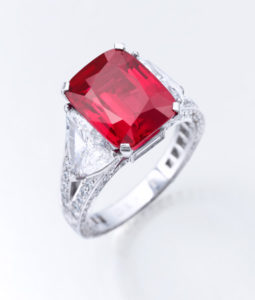
Graff ruby ring
Graff Ruby Ring

One of “The Big Three”, ruby is considered the King of Gems. Throughout time, ruby has been historically the most prized of all colored gemstones. Worn only by royalty for many centuries, rubies are mined in Thailand, Burma, and Sri Lanka, with Vietnam and southeastern parts of Africa as more recently discovered sources. Ruby is second only to diamond in hardness, along with sapphire its mineral cousin.

“Pigeon’s blood” red is considered the finest red in ruby. Myanmar (formerly Burma) is the source of the world’s finest quality rubies. Burma’s finer rubies have become increasingly more difficult to find. It is speculated that the mines were played out several decades ago and what was coming out were hoarded goods. However, the U.S. banned trade with Myanmar in 2003. Since then, the trade was limited to what was left in U.S. wholesalers’ coffers, resulting in a spike in pricing. Recently, the embargo on Myanmar was lifted, and Burma ruby can now be found more readily available. In the meantime, African ruby has made a name for itself presenting some very fine specimens.

Myanmar is also home to a huge supply of commercial (low) quality ruby, mined in the Mong Hsu region. These stones are opaque, highly included, and milky. Extensive heat treatments, along with filling, make these stones marketable.

Ruby Treatments

Rubies are routinely heat treated to enhance their clarity and color. Natural, unheated rubies are extremely rare and command double the price in lower qualities and sizes and more than ten times the price in top quality, larger gems. More recently, commercial quality rubies have been heated and impregnated with a leaded glass substance. In these highly fractured stones, the leaded glass “heals” the fracture and makes it less visible. The level of this treatment can be minimal to extensive, depending on the extent of fracturing throughout the stone. The color of these rubies is pleasant, and the treatment not apparent to the untrained eye. However, care in wearing is essential for these types of treated rubies as the glass filling can be affected by common household cleansers as well as a jeweler’s torch.

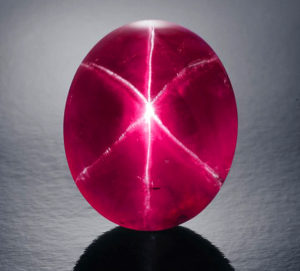
Star Ruby

DeLong Star Ruby
DeLong Star Ruby

Star rubies are mined only in Burma and Sri Lanka. The star is caused by a reflection of rutile needles within the gemstone, intersecting in a hexagonal pattern (following the hexagonal crystal growth). As with sapphires, they are difficult to find due to the prevalence of heat treatments. The DeLong Star Ruby, weighing 100 carats, was stolen in an infamous jewelry heist in the 1960’s. A ransom was paid and it was dropped off at a phone booth in Florida and ultimately recovered. It is now on display at the American Museum of Natural History.

July’s birthstone, ruby is a perfect option for rings, even for men, due to its hardness and durability. Many medieval Europeans wore rubies to secure health, wealth, and wisdom. Red is the color of passion, and ruby is thought to attract love. It is also believed to bring success in business. Ruby represents the 40th wedding anniversary.

Filed Under: Blog

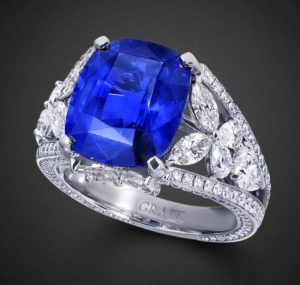
Sapphire

Ceylon sapphire ring
Graff sapphire

Worn by royalty throughout history, sapphire belongs to the corundum mineral group along with ruby.  In ancient times, it was believed that sapphire colored the sky.  Sapphire is a classic; one of the “Big Three”. It rates 9 on the Mohs scale, second only to diamond and is considered durable enough even for men’s wear. It is a popular alternative for an engagement ring. However, as with all fine jewelry, diamonds, and gemstones, sapphire requires some care in wearing. Sapphires can chip and scratch with heavy wear, so it’s recommended to take your rings off when active.

Due to sapphire’s high refractive index and hardness, they are a vibrant gemstone. Blue is the most common color, but sapphire is found in almost every color in the rainbow. Sapphires are mined in Australia, Burma, Sri Lanka, and East Africa. Sapphires are also mined in Montana and are named “Yogo” sapphires for their Yogo Gulch origin.

Fine cornflower blues are typical in “Ceylon” or Sri Lankan sapphires. Some consider this color bright and open. Vivid blue is the most valuable, mainly mined in Burma. However, the pinnacle of fine color blue sapphire is the Kashmir sapphire. Discovered in the late 19th century, sapphires mined in the Kashmir region display an electric blue unrivaled by any other. The mine was exhausted only 50 years after it was discovered, and you will only see Kashmir sapphires from older jewelry.

Most “blue” sapphire that’s marketed today is mined in Australia, the largest volume producer of sapphire in the world. This commercial (low) quality sapphire is dark ink blue and runs about $300 retail for a one-carat gemstone.  Fine quality sapphire runs $3,000 to $4,000 for a one-carat gemstone.

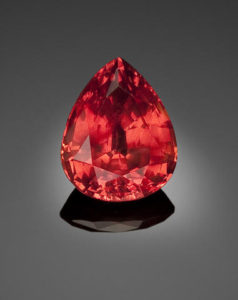
Padparadscha Sapphire

Padparadscha is the rarest color of sapphire. Think of the color of a warm tropical sunset. Orangey­ pink, a perfect balance of the two. These gems are even scarcer than fine rubies.

padparadscha sapphire

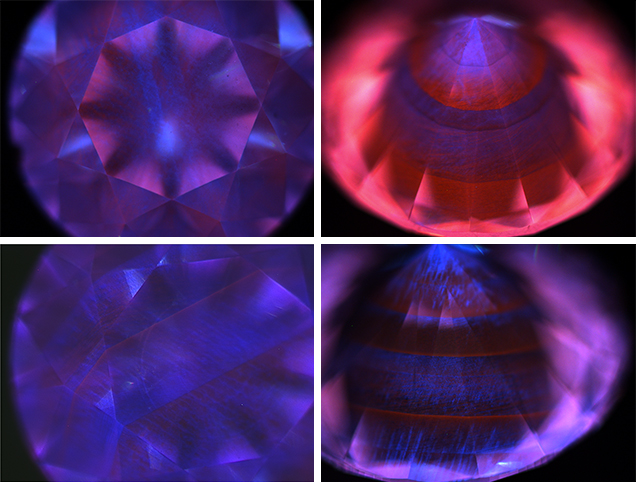
The vast majority of sapphires of all colors are heated to raise clarity (dissolve inclusions)  and enhance color. Diffusion is another type of treatment used to enhance color. Diffusion is a highly contested form of sapphire treatment, mainly due to the fact that the color saturation is only skin deep and can be affect with scratching or re-polishing.

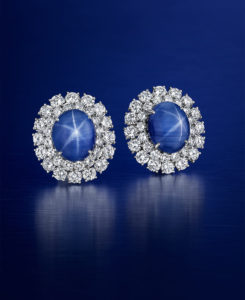
Star Sapphire

APairofStarSapphireandDiamondEarClipsbyCartier

Star sapphires and rubies are a phenomenal gem. Reflection of rutile needles within the gemstone cause the star, or asterism, intersecting in a hexagonal pattern (following the hexagonal crystal growth). Fine star sapphires were very popular about 40 years ago, but the industry has seen a decrease in availability of stars due to the prevalence of heat treatments at the source.  Quality factors in stars are a sharp (not blurry or wavy) six-sided star that extends to the edges. A top-quality gem will be translucent with a top not too high or shallow and a bottom not too heavy. And, of course, saturation of color is important.

Sapphire is said to foster creative expression, intuition, meditation, and mental clarity. It is also considered an antidote for depression. Medieval Kings believed that sapphire would protect them from harm and envy. By the time of the Renaissance, sapphires were coveted by the wealthy and influential. Sapphires were credited with the ability of preventing poverty, making an irritable man good-tempered and a stupid man wise.

Blue sapphire is considered September’s birthstone as well as representing the 5th and 45th wedding anniversaries. All sapphires are durable and wear well in rings.

Filed Under: Blog

a diamond is forever debeers

“A Diamond is Forever”. DeBeers’ marketing arm created this classic tag line back in the 1950’s. Technically, diamonds are forever. They are the hardest mineral on earth and are handed down through generations….at least most of the time. There are cases, however, when your diamond may not be yours forever. Here are some of the most common ways diamonds make their way out of your possession.

Disposal disaster – Your ring sits on the kitchen sink counter while you wash your dishes. One swipe and it flies into the drain and too far down to retrieve. The teeth of the disposal munching on your diamonds, you can almost hear the sound of memories and thousands of dollars swirling down the drain. You can’t seem to get to the off switch fast enough…

Out with the trash – You have your very own secret hiding place, unique in nature. Your toddler finds it and gets a hold of your ring and thinks the trash receptacle is a good place for it. Or, another family member makes their way through hauling miscellaneous items away for the trash, your ring stash included.

Hello there, Beautiful – Leaving your jewelry out on display. Whether at home or on vacation, leaving your jewelry out in the open invites opportunists to make away with your precious pieces.

Rocks in your Pockets – Your pockets seem like a safe place to put your ring to apply lotion to your hands. Hours later (and possibly miles later, too) you suddenly remember your ring…..just to have it slip out when you were seated or slip through a hole in the stitching.

Slippery Slope – Your ring is just a tad too loose and you haven’t had the chance to get to the jeweler for resizing. One wash of the hands or pulling off of the winter gloves and your diamond ring is flung to unknown places.

Moving Madness – No thought given when you purchase that new home, you start packing and moving boxes….and later discover that your center diamond did not make it in the move. Prongs broken and memories lost.

Hopefully, none of these will happen to you. Are you prepared if it did? Make sure your valuable jewelry is scheduled on your insurance policy for the greatest protection. And be certain to keep your jewelry appraisals up to date, every 2-3 years is recommended. Hence, it’s better to be safe than sorry.

Filed Under: Blog Tagged With: a diamond is forever, appraisal, diamonds, insurance, jewelry

Summertime is peak time for home sales. Real estate signs pop up like daffodils in the spring and continue long into the summer months. If your home is on the market, there is a never-ending laundry list of “to-do’s.” If you’re not moving, you likely are not off the hook either. Protecting your jewelry is a must on the “to-do” list.

Homeowner’s Insurance and Your Jewelry Coverage

jewelry appraisal insurance homeTwo out of three homeowners purchase their home during the summer months. If that includes you, your insurance policy renews at that same time of year. Your insurance agent will likely send you a statement showing the coverages of your home and contents for the upcoming year along with the annual premium rate. Although this is a very important document to review in general, it is even more important to review the scheduled items section – your most treasured personal possessions.


Furs, rugs, fine art, wine collections and jewelry could very well be a part of your scheduled coverage. This special coverage protects these valuables and should reflect the current cost to replace them. Your appraisal helps define your insurance policy needs and assures a comparable replacement in the event of a loss. Weather, the economy, production costs and demand are all factors that influence the markets of these collections. Due to the changes in these markets, it is likely that you are not fully covered under your current policy limits….if you have not had your appraisals updated in the past two to three years.

Seeking out a Professional Appraiser

Seeking out a professional appraiser for your valuable personal property is imperative. Unlike real estate appraisers, personal property appraisers are not licensed. And, there is very little federal or state oversight of these appraisers. So, how do you find a professional appraiser for your most treasured possessions?

Your appraiser should have the experience and qualifications to do the job right. Beyond education and experience in the field specialty they practice, find an appraiser who is formally educated in appraisal methodology, appraisal report writing, and be USPAP compliant. Look for an appraiser who has undertaken the accreditation requirements of professional appraisal organizations like the International Society of Appraisers, American Society of Appraisers, and Appraisers Association of America. After all, your appraisal is an important document that will help protect you. Simply put, your appraisal is your peace of mind.

Filed Under: Blog Tagged With: appraisal, home buying, insurance, jewelry


diamonds, jewelry, appraisal

Spring rolls around like clockwork every year. And every spring, I can count on seeing clients who have gone on vacation to sunny destinations and brought back jeweled baubles from their trip. Their stories are unique, but the theme is the same – “Boy, did I get taken…did I pay too much?”

It takes me back to a three-part series of articles I wrote last year titled, “Going on a Tropical Vacation? Why You Should Bring Home T-Shirts, Not Jewelry.” Here are links to Part I, Part II, and Part III. These three stories are worth reading, especially if you plan to travel to the tropics.

So far, those clients that have sought an appraisal for their vacation purchases have been disproportionately disappointed with their purchase. Most feel like they did not get a good value for the money spent. And when you’re spending thousands of dollars, that’s the last thing you want to feel.

If you’re headed on a tropical vacation soon, my advice – pick up some T-shirts!

Filed Under: Blog

jewelry appraisal pearl diamondIf yes, lucky you!

Wearing jewelry makes us feel treasured, especially when it’s been given by a loved one. First of all, don’t let another day pass before you insure your new gem. The last thing you want is the possibility of losing it and not being able to replace it.

Here are some tips for insuring your new (and not so new) jewels:

  • What is the standard coverage limit for jewelry on your homeowner’s policy? Each policy is different; and in some cases you have a choice as to what standard coverage limit you have. Talk with your insurance agent about your options.
  • What is your comfort level of risk? Is there jewelry in your box that you may not be absolutely broken hearted about if it were gone? Or, maybe you have a high level of risk comfort and a savings account to back it up. If you suffered a loss, you may be able to carry some of that risk by replacing your lost items with your own cash.
  • If you schedule your jewelry, is there a deductible to consider? Some policies have deductibles; others have $0 deductible. Check with your agent.
  • Should you insure your jewelry under your homeowner’s policy or a separate policy? You have a choice in the matter. Talk with your insurance agent about your options. There are even some insurance companies, i.e. Jewelers Mutual, that specialize exclusively in jewelry coverage.
  • BEWARE of the inflated appraisal. Inflating the value on your appraisal simply means that you will pay higher insurance premiums. As a result, many people discover too late that an insurance company will not pay more than current market value (the $ amount you paid).
  • Who appraised your jewelry? As important as your appraisal is, it is even more important who is appraising your jewelry. Unlike real estate appraisers, personal property appraisers are not required licensing. It’s up to you to find a credentialed jewelry appraiser who can professionally appraise your valuables. Look for an appraiser who has undertaken the accreditation requirements of a professional appraisal organization like the International Society of Appraisers or American Society of Appraisers. Expect nothing less.
  • Do you have a recent appraisal on your not-so-new jewelry? Whether you have your jewelry scheduled or insured under a blanket policy, get an up-to-date appraisal that will provide detailed information and a current replacement value to ensure comparable quality jewelry is replaced in case you experience a loss.

Filed Under: Blog Tagged With: appraisal, Christmas, diamonds, insurance, jewelry

labor day jewelryIn observation of Labor Day, I honor the people who work passionately to mine and cut the beautiful gems and design and craft the jewelry we wear and love. Here’s to you!

Click on each link to see inside the world of:

Diamond Miners

Diamond Cutters

Gemstone Cutters

Jewelry Design Artists

Jewelry Designers

Goldsmiths

Diamond Setters

Engravers

Filed Under: Blog

synthetic diamondAlthough it seems that synthetic (man-made) diamonds are new on the scene, they have been around for decades. In fact, three scientists in early 20th century claimed to have manufactured diamonds. General Electric was the first to synthesize diamonds with proven success in the early 1950’s. Since then, synthetic diamonds have been used for industrial purposes (think, diamond coated saw blades and drill bits). More recently, a division of DeBeers, Element Six manufactures synthetic diamonds for numerous applications in industries ranging from Aerospace to Healthcare, asserting, “Synthetic diamond’s molecular structure makes it the world’s most versatile supermaterial.”

In the world of jewelry, diamond simulants, such as cubic zirconia and moissanite, have been popular choices for those who want the look of diamond. However, simulants can be scratched and chipped much easier than diamond. Diamond is simply superior in every way. Because synthetic diamonds are the same physically and chemically as natural, earth-mined diamonds, they, too, are superior to all other simulants. This is great news for those who want the look of natural diamond along with unrivaled wearability.

The challenge for lab-grown diamond producers has been the ability to grow a colorless, gem quality diamond of a popular size at a reasonable price. As with any newly developing technology, advances in both quality and size as well as managing the cost of producing these diamonds so that they are available to the consumer at competitive prices has been a long journey. That journey is now starting to pay off as synthetic diamond producers are able to make 1-carat plus size diamonds available in relatively steady supply.

Consumers’ feedback shows that the appeal to purchasing a synthetic diamond is that they avoid the possibility of buying a conflict diamond. And price is attractive as well. Industry insiders report some worry from diamond wholesalers and retailers that synthetic diamonds will be the end of the natural diamond market. But, as history has shown, synthetic rubies, sapphires and emeralds have been on the market for about a century, yet the naturals rival their lab-grown counterparts today.

Would you consider purchasing a synthetic diamond?

Filed Under: Blog

Harold tivol jewelryA little more than a week ago, I heard the news that my mentor, Harold Tivol, had passed away. He was 92. If you’re from Kansas City, you likely recall Harold in his TV commercials. My favorite one is where it appears that you’re looking over the surface of the moon until the camera pans out and it turns out to be Harold’s bald head. Probably his most popular commercial is this one – https://www.youtube.com/watch?v=a4ckFrrefFo – celebrating Tivol’s 100th anniversary.

With Harold, what you see is what you get. As funny as he was in his commercials, he was just as fun-loving at the store every day he was there. And he was in the store every day well into his late 80’s. He LOVED being in the jewelry business. He loved it not for the money. That was a nice by-product, but his love was for the gemstones that were mined and fashioned into brilliant colors of the rainbow, and of the craftsmanship that defines the art of jewelry.

Beyond all of that, though, was Harold’s love of sharing his passion and his instinctive need to tell the truth, the whole truth. Telling the truth required always seeking the truth. Harold was a perpetual learner and caring teacher.

My career began at Tivol in 1988 directly after graduating from the Gemological Institute of America. That year, Harold received the Modern Jeweler Lifetime Achievement Award. His smiling face was on the cover of one of the most recognized industry magazines. I wouldn’t discover how lucky I was to work under Harold until years later when I came full circle and rejoined Tivol in 2006 as the Senior Gemologist and Appraiser.

I recall my final interview with Harold before I was hired. He asked me to appraise his Cat’s-eye Chrysoberyl ring on the spot. It was his prized piece of jewelry. He wore it every day. It’s a heavy platinum ring with diamonds flanking the exquisite and rare center Cat’s-eye. I told him that I don’t shoot from the hip. A thorough analysis of his Cat’s-eye and diamonds and research of the markets for value would take time. He grinned his signature grin and said, “I like your answer!”.

During my second term of service at Tivol, Harold would come into my office to talk business and to see what jewelry I was appraising that day. During our conversations, we sometimes had varying opinions and we would debate. He shared with me his wisdom and experience. I shared with him new trends that were happening that affected us and our clients. Harold kept me on my toes, and I thrived on his challenge to always do my best. It really hit me during these later years how much influence Harold had on me during those first years in my career. He didn’t even have to try. It was contagious, his drive to hold a high standard of ethics, to give information to empower others, to serve in the industry.

Now that I own my own business, I think of Harold often. My business model is to serve others with a bit of humor mixed in and with the highest level of honesty, integrity, and professionalism. As I carry on, Harold will always be a part of who I am at the Appraiser’s desk. He will always be a part of me, period.

Filed Under: Blog

« Previous Page
Next Page »

Kahle Appraisals

13451 Briar Drive, Suite 200
Leawood, KS 66209
Phone: (913) 912-9122
Email: tracey@kahleappraisals.com

Kahle Appraisals - Facebook Kahle Appraisals - LinkedIn Kahle Appraisals - Alignable

Directions

© 2023 | Kahle Appraisals | All Rights Reserved | XML Sitemap | Site by Bonnie Rivas