Kahle Appraisals

  • Home
  • About
    • Tracey Kahle
    • Credentials
    • Community Involvement
  • Beyond Worth
  • Services
    • Preferred Service Provider
    • Partner Appraisers
  • FAQ
  • News
  • Contact

Is Your Diamond Certificate Bogus?

Home/Archives forBlog

How to tell if your diamond certificate and appraisal are legitimate.
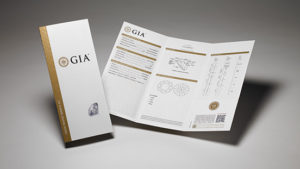
GIA Diamond Grading Report

Starting the diamond buying process by educating one’s self about diamonds is the smart thing to do. Learning the Gemological Institute of America’s “4 C’s” of diamond quality to help determine how best your money is spent is important. Many diamonds these days are accompanied by a “diamond certificate” or diamond grading report. This is a third-party assessment of quality factors. But how do you know if your diamond certificate is legitimate or even worth the paper it’s printed on?

I was driven to write about this subject after having a few separate clients seek an appraisal on their recent new diamond purchases. Each of these clients had bought their diamond rings online. They all felt like they had done their due diligence in determining what quality of diamond they intended on purchasing. And the rings were delivered with what appeared to be an authentic lab report issued by the Gemological Institutes Services (GIS).

But it turns out the diamond certificate delivered with their new ring was bogus. Not only was the clarity overstated, resulting in a gross exaggeration of quality. The “replacement value” reported was also extremely inflated, indicating that the diamond was worth triple the price paid. As it turns out, all the diamonds were very low quality (I-2 to I-3) and had been clarity enhanced to improve their appearance. The clarity enhancement used is called “fracture filling” and is a process by which leaded glass is injected by vacuum into fissures inside the diamond. Fracture filling is relatively stable. But it can be damaged with heat during repairs and sometimes harsh chemicals used in cleaning products. None of my clients were aware they had purchased a treated diamond. Furthermore, the clarity grade stated on each of these so-called “diamond certificates” did not accurately reflect the apparent clarity post-treatment.

Did they get what they paid for?

Yes and no. Was the price they paid fair for what they received? Yes. Were they accurately informed about what they were getting? No. You’ve likely heard the proverb, “You can put lipstick on a pig, but it’s still a pig.” The GIS diamond certificate is the lipstick in this case.

How to avoid a similar experience when shopping for diamonds? Look for a diamond certificate, or grading report, issued by the Gemological Institute of America (GIA). GIA is the leading authority on diamonds and diamond grading. Accept nothing less and you are guaranteed accurate reporting of diamond qualities and any treatments that may be present.

Also, take a look at the appraisal that may have been issued with your purchase. If the replacement cost stated is well above your purchase price, consider that a red flag and get a second opinion. The seller of your new ring is motivated to make you feel that you received an exceptional deal. That inflated value will only disserve you.

When insuring your new ring, the premium you pay is, in large part, related to the value stated on your appraisal. And, if you suffer a loss, your insurance company is most certainly not going to pay out more than your diamond is really worth. Don’t get sucked into paying more in insurance premiums than you should. If you feel you have an inflated appraisal, seek out an independent jewelry appraiser for an accurate assessment and appraisal report.


Filed Under: Blog

Professional appraisers are experienced in distinct areas and practice within these “specialties.” They have gained education and experience related to these areas that help them assess the valuables you need appraised. Whether it’s jewelry, wine, books, fine art, or a myriad of other collectibles, we have you covered. Introducing my appraiser partners:

Charles Keller

Charles Keller

Charles has worked as a personal property appraiser, consultant, researcher, and writer specializing in historical artifacts, rare and antiquarian books, fine art, and antiques for over 19 years. He earned his degree in History from UMKC in 1995, with emphasis on the cultural, political and military history of the 19th and 20th centuries, and the history of science. He has also attended the Rare Book School at the University of Virginia where he specialized in the principles of bibliographic description of books of the hand press era, 1450-1800.

While having chosen to work outside academia, he has nevertheless consulted with or made special presentations for numerous institutions around the world, including the New York Metropolitan Museum of Art, Philadelphia Museum of Art, Nelson-Atkins Museum of Art, Vincent van Gogh Museum, Amsterdam, the University of Illinois Special Collections Archive, Imperial War Museum, London, and others. He also served on the board of trustees of the National World War I Museum, as well as on the museum’s accessions committee.

Charles has worked with historical pieces spanning millennia, from ancient Egyptian artifacts to former Iraqi president Saddam Hussein’s uniforms. He maintains membership in the International Society of Appraisers (ISA), as well as an international network of colleagues in academic and appraisal circles to assist with complex projects or specialized research.

He currently serves on the executive committee of the H.G. Wells Society in the UK, regularly contributes to society publications, makes frequent appearances in media, including radio in the US and UK, and as a fact checker for various news organizations. He continues to publish on various aspects and periods of history, with his current research focusing on the international cultural impact of Weimar-era German cinema.

Rachael Blackburn Cozad

Rachael Blackburn Cozad

The Principal of Madison Group Fine Art Appraisals, Rachael offers over twenty-five years of comprehensive experience in the visual arts and is a certified member of the Appraisers Association of America.

From 2001-2012 she was the Director of the Kemper Museum of Contemporary Art in Kansas City, Missouri, an institution recognized for its collection of modern and contemporary art, for its exciting exhibitions of work by established and emerging artists, for its large-scale public art projects, and for its Collectors Forum program for art collectors. Prior to this, Rachael was Executive Director and Chief Curator of the Iris and B. Gerald Cantor Foundation in Los Angeles, which controls the world’s largest collection of sculpture by the 19th Century French master Auguste Rodin.

Rachael has curated exhibitions for many major museums including The Metropolitan Museum of Art, The Brooklyn Museum of Art, Los Angeles County Museum of Art, Philadelphia Museum of Art, and the Kemper Museum. She has led major projects at The White House and New York’s Rockefeller Center and internationally, in Australia, France, Russia and Singapore. Her record of publications produced in conjunction with these exhibitions is extensive.

Rachael holds an M.A. in art history from California State University, Los Angeles, and a B.A. from Texas Christian University. She serves as a peer reviewer for the U.S. General Services Administration’s Art in Architecture program and also for the Museum Assessment Program managed by the American Association of Museums. She is a former Chair of the Southern California chapter of ArtTable, a national organization for professional women in leadership positions in the arts and a current member of the advisory panel for Art 21: the award-winning PBS television series on the visual arts.

Filed Under: Blog Tagged With: appraisal, appraisals, appraisers, insurance

Emerald

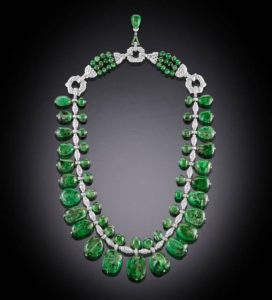
Cartier Art Deco emerald and diamond necklace

Emerald was regarded as magical and mystical to ancient Egyptians.  The Inca and Aztecs found great wealth in the abundant emeralds of the Yucatan. Eventually, Spaniards, who discovered the western hemisphere, returned to Europe with the finest emeralds they had ever seen. Hernando Cortes, the conqueror of Mexico, tried to bring huge chunks of Emerald that he took from the Aztecs back home with him. However, one of his ships was shipwrecked, and delicately carved Emeralds in the shape of flowers and fish and other rare Emeralds, including an Emerald the size of a man’s palm were lost forever.

Colombia, Brazil, and Zambia are major sources of emerald. Colombia, however, is well known for the finest quality and commands a premium. Emeralds, by nature, are more heavily included than other gems.  To find an eye-clean emerald is extremely rare.

Zambian emerald rivals the saturation of Colombian emeralds. However, they tend to be darker in tone. Zambian emeralds are generally cleaner internally than Colombian, so they tend to be a great option for the middle price range.

Brazil is the main source for commercial color emeralds. Washed out in appearance, they do have the redeeming quality of above-average clarity.

Emerald Treatments

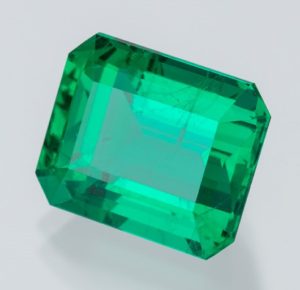
loose emeraldEmeralds are routinely “oiled” to reduce the visibility of natural fractures within the stone. Oiling, and more recently Opticon (an epoxy resin), impregnation is an acceptable trade practice and has been for well more than a century.  Occasionally, dye is added to the oil to enhance color.  This is not considered acceptable in the trade.
The emerald market suffered in the early 2000’s due to some controversy over oiling treatments, disclosure, and pricing of emeralds in relation to the extent of oiling. Prices fell 30%-50% and the market remained soft for several years until a recent resurgence.  Emerald prices have just recently seen a full recovery from that downturn.

Trapiche Emerald

Trapiche emerald
Trapiche emerald

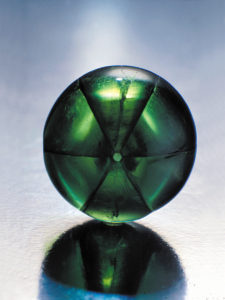
Trapiche emeralds are an extremely rare variety of emerald. Cut in cabochon form, they display a hexagonal center with six radiating sections, following the growth of the original crystal. These rarities are found only in the Muzo mining district of Colombia. The Spanish name trapiche was attached to this unique gem due to its similarity in appearance to a wheel used for grinding sugar. A top quality trapiche emerald may display a glow or chatoyancy caused by fine needle-like inclusions.

Emerald is May’s birthstone and represents the 20th and 35th wedding anniversaries. This gem can be worn in a ring, but special care is recommended in wearing.  Emeralds should never be cleaned by ultrasonic or steamer. Soap and water with a toothbrush is the best cleaning method.

Filed Under: Blog

Ruby

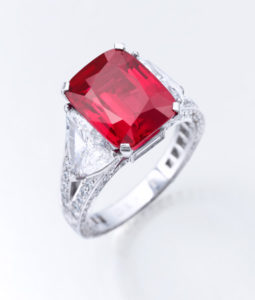
Graff ruby ring
Graff Ruby Ring

One of “The Big Three”, ruby is considered the King of Gems. Throughout time, ruby has been historically the most prized of all colored gemstones. Worn only by royalty for many centuries, rubies are mined in Thailand, Burma, and Sri Lanka, with Vietnam and southeastern parts of Africa as more recently discovered sources. Ruby is second only to diamond in hardness, along with sapphire its mineral cousin.

“Pigeon’s blood” red is considered the finest red in ruby. Myanmar (formerly Burma) is the source of the world’s finest quality rubies. Burma’s finer rubies have become increasingly more difficult to find. It is speculated that the mines were played out several decades ago and what was coming out were hoarded goods. However, the U.S. banned trade with Myanmar in 2003. Since then, the trade was limited to what was left in U.S. wholesalers’ coffers, resulting in a spike in pricing. Recently, the embargo on Myanmar was lifted, and Burma ruby can now be found more readily available. In the meantime, African ruby has made a name for itself presenting some very fine specimens.

Myanmar is also home to a huge supply of commercial (low) quality ruby, mined in the Mong Hsu region. These stones are opaque, highly included, and milky. Extensive heat treatments, along with filling, make these stones marketable.

Ruby Treatments

Rubies are routinely heat treated to enhance their clarity and color. Natural, unheated rubies are extremely rare and command double the price in lower qualities and sizes and more than ten times the price in top quality, larger gems. More recently, commercial quality rubies have been heated and impregnated with a leaded glass substance. In these highly fractured stones, the leaded glass “heals” the fracture and makes it less visible. The level of this treatment can be minimal to extensive, depending on the extent of fracturing throughout the stone. The color of these rubies is pleasant, and the treatment not apparent to the untrained eye. However, care in wearing is essential for these types of treated rubies as the glass filling can be affected by common household cleansers as well as a jeweler’s torch.

Star Ruby

DeLong Star Ruby
DeLong Star Ruby

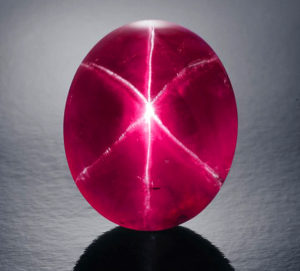
Star rubies are mined only in Burma and Sri Lanka. The star is caused by a reflection of rutile needles within the gemstone, intersecting in a hexagonal pattern (following the hexagonal crystal growth). As with sapphires, they are difficult to find due to the prevalence of heat treatments. The DeLong Star Ruby, weighing 100 carats, was stolen in an infamous jewelry heist in the 1960’s. A ransom was paid and it was dropped off at a phone booth in Florida and ultimately recovered. It is now on display at the American Museum of Natural History.

July’s birthstone, ruby is a perfect option for rings, even for men, due to its hardness and durability. Many medieval Europeans wore rubies to secure health, wealth, and wisdom. Red is the color of passion, and ruby is thought to attract love. It is also believed to bring success in business. Ruby represents the 40th wedding anniversary.

Filed Under: Blog

Sapphire

Ceylon sapphire ring
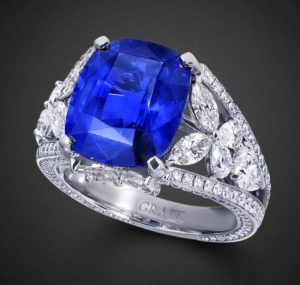
Graff sapphire

Worn by royalty throughout history, sapphire belongs to the corundum mineral group along with ruby.  In ancient times, it was believed that sapphire colored the sky.  Sapphire is a classic; one of the “Big Three”. It rates 9 on the Mohs scale, second only to diamond and is considered durable enough even for men’s wear. It is a popular alternative for an engagement ring. However, as with all fine jewelry, diamonds, and gemstones, sapphire requires some care in wearing. Sapphires can chip and scratch with heavy wear, so it’s recommended to take your rings off when active.

Due to sapphire’s high refractive index and hardness, they are a vibrant gemstone. Blue is the most common color, but sapphire is found in almost every color in the rainbow. Sapphires are mined in Australia, Burma, Sri Lanka, and East Africa. Sapphires are also mined in Montana and are named “Yogo” sapphires for their Yogo Gulch origin.

Fine cornflower blues are typical in “Ceylon” or Sri Lankan sapphires. Some consider this color bright and open. Vivid blue is the most valuable, mainly mined in Burma. However, the pinnacle of fine color blue sapphire is the Kashmir sapphire. Discovered in the late 19th century, sapphires mined in the Kashmir region display an electric blue unrivaled by any other. The mine was exhausted only 50 years after it was discovered, and you will only see Kashmir sapphires from older jewelry.

Most “blue” sapphire that’s marketed today is mined in Australia, the largest volume producer of sapphire in the world. This commercial (low) quality sapphire is dark ink blue and runs about $300 retail for a one-carat gemstone.  Fine quality sapphire runs $3,000 to $4,000 for a one-carat gemstone.

Padparadscha Sapphire

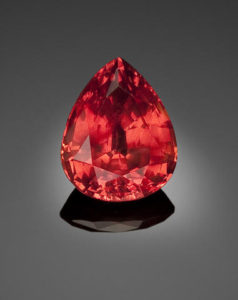
Padparadscha is the rarest color of sapphire. Think of the color of a warm tropical sunset. Orangey­ pink, a perfect balance of the two. These gems are even scarcer than fine rubies.

padparadscha sapphire

The vast majority of sapphires of all colors are heated to raise clarity (dissolve inclusions)  and enhance color. Diffusion is another type of treatment used to enhance color. Diffusion is a highly contested form of sapphire treatment, mainly due to the fact that the color saturation is only skin deep and can be affect with scratching or re-polishing.

Star Sapphire

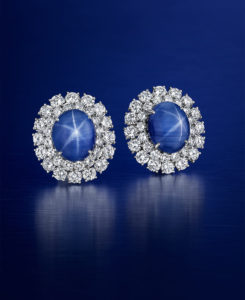
APairofStarSapphireandDiamondEarClipsbyCartier

Star sapphires and rubies are a phenomenal gem. Reflection of rutile needles within the gemstone cause the star, or asterism, intersecting in a hexagonal pattern (following the hexagonal crystal growth). Fine star sapphires were very popular about 40 years ago, but the industry has seen a decrease in availability of stars due to the prevalence of heat treatments at the source.  Quality factors in stars are a sharp (not blurry or wavy) six-sided star that extends to the edges. A top-quality gem will be translucent with a top not too high or shallow and a bottom not too heavy. And, of course, saturation of color is important.

Sapphire is said to foster creative expression, intuition, meditation, and mental clarity. It is also considered an antidote for depression. Medieval Kings believed that sapphire would protect them from harm and envy. By the time of the Renaissance, sapphires were coveted by the wealthy and influential. Sapphires were credited with the ability of preventing poverty, making an irritable man good-tempered and a stupid man wise.

Blue sapphire is considered September’s birthstone as well as representing the 5th and 45th wedding anniversaries. All sapphires are durable and wear well in rings.

Filed Under: Blog

« Previous Page
Next Page »

Kahle Appraisals

13451 Briar Drive, Suite 200
Leawood, KS 66209
Phone: (913) 912-9122
Email: tracey@kahleappraisals.com

Kahle Appraisals - Facebook Kahle Appraisals - LinkedIn Kahle Appraisals - Alignable

Directions

© 2026 | Kahle Appraisals | All Rights Reserved | XML Sitemap | Site by Rivas Web Services